
A New Paradigm: Specification-Driven Development and IKEA Software
The software development landscape appears to be undergoing a significant shift lately. With the rapid advancement of code generation tools, AI-powered assistants, and generative AI, we're witnessing the revival of Specification-Driven Development (SDD)—a paradigm that was once promising but lacked the tooling to reach its full potential.
This transformation became evident through recent developments: the excitement surrounding Claude Code, the release of Kiro, and the growing ecosystem of AI development tools. These aren't just incremental improvements—they represent a paradigm shift in how we approach software creation.
The IKEA Software Metaphor
To understand this shift, I would like to use furniture as a metaphor where consumers already have a broad spectrum of choices: handcrafted pieces at one end, mass-produced items at the other, and everything in between. Each option serves different needs, budgets, and time constraints.
Until now, software development has offered a narrower spectrum, from custom software solutions to commercial off-the-shelf products. However, there was a missing middle ground: the equivalent of IKEA furniture for software. A solution that's customizable to some extent, affordable yet functional, and accessible to a broader audience.
SDD, powered by modern AI tools, has created this missing category. We can now build what I like to call "IKEA Software"—applications built in a specification-driven way, rapidly assembled, and more than sufficient for a broad variety of use cases.
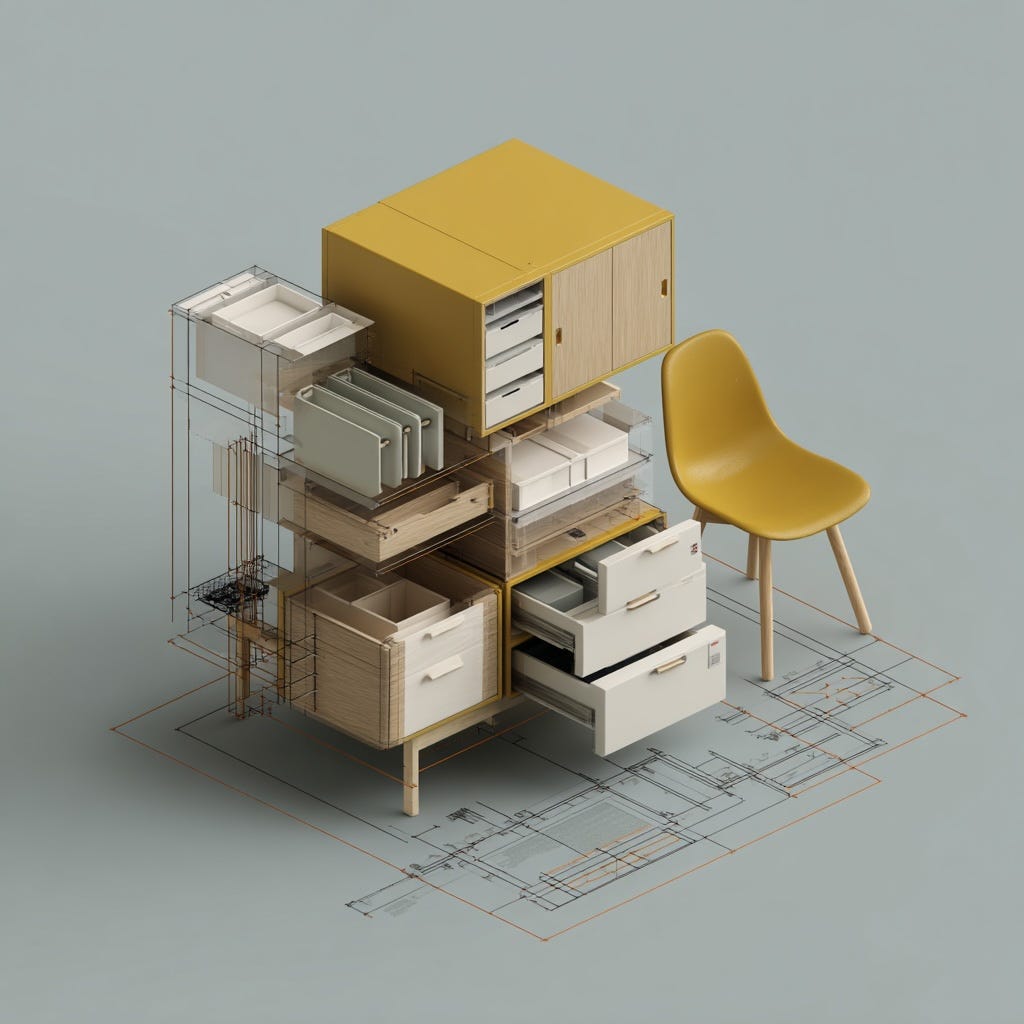
Characteristics of IKEA Software
IKEA Software is enabled by rapid development from specification, bringing you working applications at a lower cost and effectively making functional software accessible to more people through standardized patterns. However, it may be less robust in edge cases, offer more limited customization for particular requirements, and may not be as performance-optimized as hand-crafted code. But for many business problems, these trade-offs are acceptable.
Assembling IKEA Doesn't Make You a Woodworker
Here's where the furniture metaphor becomes crucial: assembling an IKEA closet doesn't make you a woodworker. The person who follows the manual to assemble a piece of furniture and uses the provided tools isn't suddenly skilled in joinery, wood selection, or furniture design principles.
Similarly, writing specifications and generating applications doesn't automatically make someone a programmer. Understanding algorithms, data structures, system design, and software architecture requires different skills from crafting good specifications.
This distinction matters because it should influence how we need to approach training, hiring, and project management in this new paradigm.
The Junior Developer Dilemma
The above raises a fundamental question for the IT industry: Should junior developers be allowed to build IKEA Software when they don't fully understand the underlying code?
The traditional argument suggests that only senior developers should use these tools. A skilled woodworker can indeed build, modify, and repair any IKEA product because they understand the underlying principles. They can spot structural issues, make custom modifications, and troubleshoot problems.
However, this perspective may be too restrictive. Consider the evolution of manufacturing: CNC machines democratized precision manufacturing. A junior woodworker can now upload a blueprint to a CNC machine and produce professional-quality components. As long as they can assemble the final product and learn the underlying skills over time, this approach accelerates their development.
The key difference is determinism. CNC machines are predictable—the same blueprint, when applied to properly calibrated machines with identical materials, produces similar results. Different CNCs may use different firmware and routing paths, but the output remains consistent. This metaphor breaks at some point because AI-powered development tools haven't yet reached this level of determinism. Currently, the same specification can generate different code implementations, something to bear in mind.
The path forward requires striking a balance between innovation and skill development. Organizations need clear guidelines for when to develop IKEA Software, perhaps with senior developers reviewing AI-generated code and hybrid teams where juniors utilize AI tools under guidance. Developers should use these tools as accelerators, not replacements for learning fundamental programming knowledge.
Another Abstraction Layer
Also note that this new paradigm isn't unprecedented. The software industry has repeatedly introduced new abstraction layers, each of which has been met with initial resistance. We started with machine code, then moved to assembler, followed by lower-level languages and higher-level languages (let's forget about 4GLs in between), where many people can no longer read bytecode or assembler. We've accepted most abstraction layers over time, including those on the infrastructure side, which have evolved from bare metal to the cloud and virtualization.
I view what's happening as the introduction of a new abstraction layer. Each transition followed a similar pattern: initial skepticism, gradual adoption, and eventual acceptance as the new standard. The developers who adapted early gained a competitive advantage, while those who resisted were eventually forced to catch up.
SDD and IKEA Software represent the latest iteration of this pattern. We're not replacing traditional development—we're adding another tool to our arsenal.
Conclusion
The emergence of IKEA Software through Specification-Driven Development represents a natural evolution in software development. Like previous abstraction layers, it will face resistance, undergo refinement, and eventually become standard practice.
Both SDD and IKEA Software deserve their place and should not get a negative connotation. The key to success lies not in choosing between traditional development and AI-assisted approaches, but in understanding when each is most appropriate. Senior developers will utilize these tools to accelerate their workflow and concentrate on more complex issues. Junior developers will use them as learning accelerators while building fundamental skills.
The future belongs to those who can effectively combine human insight with AI capability, creating better software faster than either could achieve alone.